
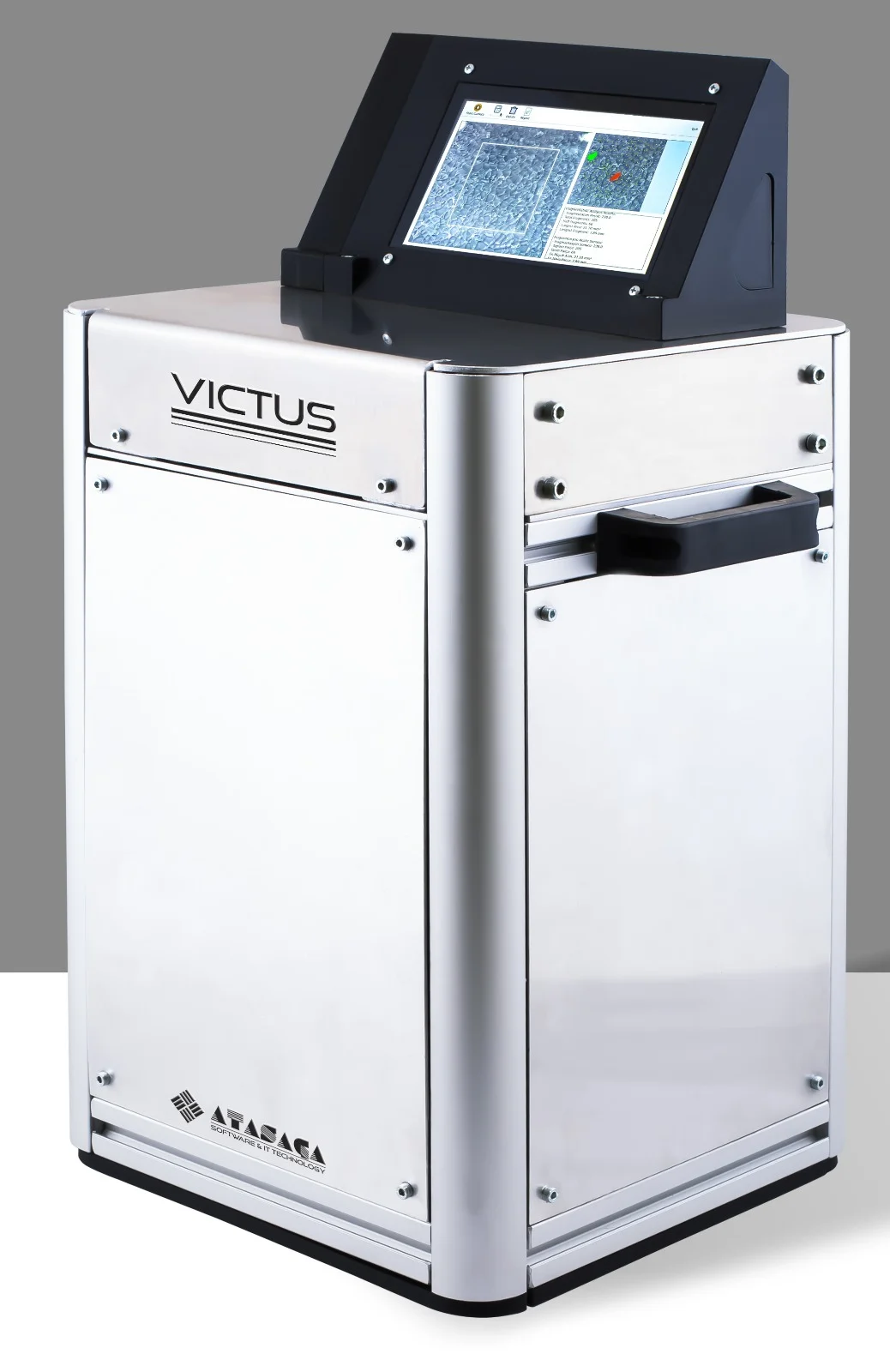
Glass quality control has relied on human inspectors for more than half a century. A trained technician, magnifying glass in hand, counting tiny fragments one by one — it was slow, tedious, and unavoidably inconsistent. Artificial intelligence is changing all of that.
Modern computer vision systems can analyze a broken glass specimen in under 10 seconds, count every fragment with sub-millimeter precision, and generate a standards-compliant PDF report — all without a human lifting a pen. Here's how it works, and why it matters.
The Core Problem: Manual Counting Doesn't Scale
EN 12150 requires manufacturers to count fragments in a 5×5 cm reference area after breaking a glass specimen. On the surface this sounds simple. In practice, a single specimen can contain several hundred fragments, many of them overlapping or touching at the edges.
Manual Counting
- 20–45 minutes per specimen
- 10–25% inter-operator variance
- Accuracy drops with fatigue
- No digital audit trail
- Difficult to scale
AI Automated
- 6–8 seconds per specimen
- <2% variance across runs
- Consistent 24/7 operation
- Instant PDF report generation
- Database integration ready
How Computer Vision Counts Fragments
The process begins with image capture. An industrial-grade camera — typically 12 megapixels or higher — photographs the broken glass specimen under controlled, uniform lighting. Consistent illumination is critical: shadows and reflections are the main sources of counting error in early automated systems.
1. Image Preprocessing
The raw image is preprocessed to normalize brightness, enhance fragment edges, and remove background noise. Contrast enhancement highlights the boundaries between adjacent fragments, which is the most computationally difficult part of the problem — two fragments touching at a flat edge can appear as a single object to a naive algorithm.
2. Instance Segmentation
A deep learning model — typically a variant of Mask R-CNN or a custom-trained segmentation architecture — identifies each individual fragment as a distinct object. Unlike simple thresholding approaches, neural networks learn to separate touching fragments based on shape curvature, edge gradients, and contextual features learned from thousands of training examples.
3. Fragment Classification
Each detected fragment is classified by size and shape. EN 12150 not only requires a minimum count — it also restricts large "splinter" fragments that could cause injury. The AI model flags any fragments that exceed the allowable dimensions, making compliance decisions automatic.
4. Reference Zone Selection
The standard requires testing the worst-case 5×5 cm zone — the area with the fewest fragments. The system automatically scans the entire specimen and identifies this zone, eliminating the subjective decision of where to place the counting grid.
The combination of consistent illumination, trained segmentation models, and automated worst-zone detection eliminates all three major sources of human counting error simultaneously.
What Changes on the Production Floor
The operational impact goes beyond speed. When testing takes 6 seconds instead of 30 minutes, manufacturers can afford to test more specimens — moving from statistical sampling to near-100% inspection on critical product lines. Problems are caught earlier, rework is reduced, and the cost per compliant unit drops.
Digital integration is equally important. Results flow automatically into quality management databases, enabling traceability from raw glass batch to finished product. When an audit or customer complaint arises, the complete fragmentation record is searchable in seconds.
The Role of Multilingual Reporting
Glass manufacturers increasingly supply international markets. A German facility supplying automotive glass to factories across Europe needs reports that satisfy quality managers in multiple countries — in their own language and format. Automated systems like Victus generate compliant PDF reports in Turkish, English, German, French, Italian, and Spanish from the same test data, with a single button press.
What to Look for in an Automated System
Not all automated analyzers are equal. When evaluating systems, manufacturers should verify:
- Camera resolution: Minimum 12 MP for reliable fragment detection at the small end of EN 12150 fragment sizes.
- Lighting control: Built-in controlled illumination, not reliance on ambient light.
- Worst-zone detection: Automatic identification of the minimum-count zone, not manual grid placement.
- Splinter detection: Not just counting — shape classification to catch oversized fragments.
- Database integration: Direct connection to MySQL, MSSQL, or PostgreSQL without middleware.
- Report format: Standardized PDF output that satisfies audit requirements.